
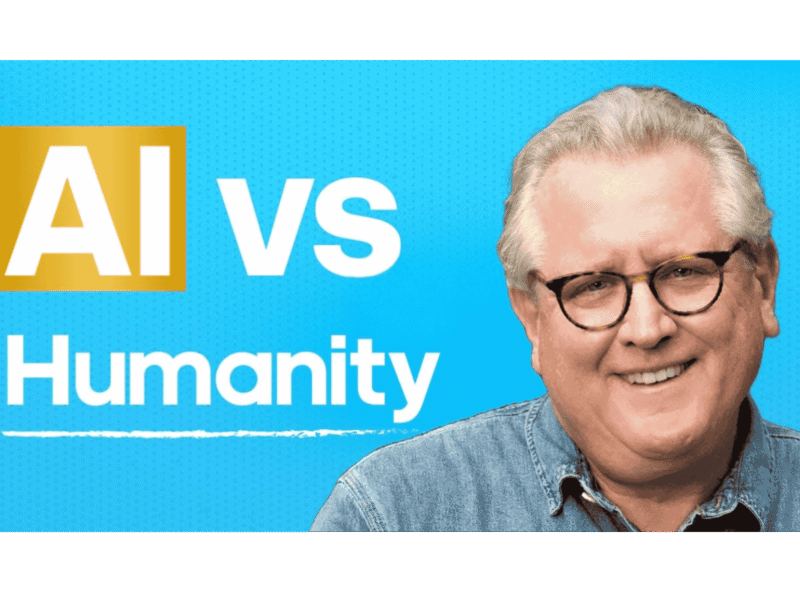
In this episode of the podcast, I sat down with Mark Schaefer to discuss a concept he has championed for years.
Mark always says that the most human company wins. I had to ask him if that is still the case today. We see so many companies being run by robots and algorithms now. Is humanity still the winning strategy?
The answer is yes, but Mark explained that the definition is evolving. In the future, the most human company might actually be a blend of real people and AI.
Table of Contents
A Human Blend
We talked about using AI where it makes the most sense. Mark noted that AI is great when people need to find the right answer fast. In customer service, AI might be perfect for solving the simple problems that happen over and over again.
However, Mark emphasized that we must remember the human touch. AI provides the illusion of empathy, but it does not really care. It does not really feel.
It is an algorithm giving you a statistical probability of a correct answer. As more of the world moves toward AI, authentic human interaction becomes a luxury and a point of differentiation.
Strategic Awkwardness
Mark introduced an idea called strategic awkwardness. He explained that messiness is actually a signal of humanity.
We discussed how people try to copy viral videos but fail because they edit everything too much. It becomes too polished. Real life has a speck of dust on the camera lens or audio that is not quite perfect.
Mark explained that this messiness makes you feel like you are there. It makes the content feel real.
That strategic awkwardness shows you are connected with a human. If you just rely on AI to generate perfect content, you become ignorable. Mark reminded us that being ignorable is the worst sin in marketing.
The Diaper Business
Mark used a great analogy about the diaper business. He explained that his grandson uses diapers, but he does not buy them. His parents make the decision. The baby is the end user, but the parents are the gatekeepers.
In marketing, AI is becoming that gatekeeper. Tech companies use AI to filter what we see. We have to create meaningful overrides to get past those filters. Mark outlined three main overrides we need to focus on to succeed.
Three Overrides
The first override Mark highlighted is the personal brand. You need to be known, trusted, and beloved. Even if AI gives a perfect answer, people will still want your specific perspective if they trust you. Mark shared a story about his trip to Paris. He did not ask AI where to find the best bakery. He asked a friend because he trusted her taste. That is an override.
The second is brand community. This is the last bastion of loyalty. People have a longing to belong. If I tell my community I have a new book, they buy it because we have a relationship, not because an algorithm told them to.
The third is transcendent content. This is content that stands out above the noise. It connects emotionally and requires real human work.
Don’t Be Boring
We discussed how most business marketing is suffering from a “pandemic of dull.” Companies are boring because it is safe and easy. AI is making this worse by helping people create average content faster. Mark described it as covering the world in mayonnaise.
To win, you have to do the work. You cannot trick people into loyalty. You have to double down on quality. You have to be generous, helpful, and consistent.
Key Takeaways
The future belongs to those who build personal brands, foster real communities, and create transcendent content. We are entering a time where AI creates the noise, but humans create the signal.
AI is a powerful tool to help us learn and be productive. But if it becomes a crutch to replace our personality, we lose our agency. The most human company still wins, but it takes determination to show that humanity.
Watch Now
If you enjoyed these insights, you can watch the full conversation below or click here to watch on YouTube.
Full Transcript
Mark Schaefer: You’ve just got to do better than AI. And AI is really good. And that has to come from really digging into your human experience and telling your stories because AI can’t do that. I think there’s a special power that will come from a person that has been through, that has suffered, that has lived and can talk to a person. You know, I know what it’s like to sob in a dark room for three days. And I want you to know I’m here for you.
Who do I marry? People are asking these questions of AI and the trust in AI is increasing. And what we’re seeing is that the purchase conversion on a question asked in AI versus Google is 23x. These are people who are looking for an answer who want to buy.
So many people they want to build their audience, they want to build their email list which is like super important. And there’s lots of tips and tricks and I’ve probably studied this more than any human alive. But it gets down to one…
Voiceover: You’re listening to the Real Business Connections Network. Real Business Connections Network. Powered by Balbert Marketing LLC. Subscribe now and check us out at realbusinessconnections.com. Enjoy the show!
Ben Albert: So Mark, you always say that the most human company wins. Is that still the case because a lot of companies are being run by robots?
Mark Schaefer: That is a very good question. It is a question that has made me pause. Because we see that AI is getting pretty darn close to a satisfactory human response, an indistinguishable human response. And some of the research I have in my book, my new book, which is How AI Changes Your Customers…
Ben Albert: I’ve got that right here Mark, I’m going to raise it up for the video camera. Reading it myself.
Mark Schaefer: It shows that in many cases people actually prefer the empathy and compassion of AI in something like customer service and even in therapy. So it’s getting that good. There’s even a story in the book about a therapist who is impressed by AI. And so it made me think, Ben, about is this still true.
And what I came down to is yes. It is true. However, in the future, the most human company might be a blend of real people and AI. We have to think about using AI where it makes sense. Where it’s judicious. Where it doesn’t get in the way. Certainly, when people need to find the right answer fast, maybe that’s something AI can do. In customer service, when people are having a problem and it’s not that hard to solve… probably 80% of companies’ problems are the same thing over and over again. AI might be perfect. And the customer might have a great experience with that.
But we also have to have that human touch. We have to remember, AI is not compassionate. AI is not empathetic. It gives the illusion of empathy. It doesn’t really care. It doesn’t really feel. It’s an algorithm. It’s math. It’s giving you a statistical probability of an answer being correct.
So I think yes, the most human company wins, and I think there’s going to be an AI component to that.
Ben Albert: It’s funny you bring this up. I sometimes talk about tactical empathy or tactical vulnerability. And I don’t like it. Let’s use this tactic to build rapport just so I can manipulate someone to buying from me. Very big in the sales world. But the AI would be the greatest of all time at utilizing those strategies. I’m going to be their friend even though I’m not their friend because the end means is the solution that I want basically.
Mark Schaefer: Yeah you bring up a really good point. That we have to remember that behind these AI interactions is a business plan. It’s weaponized empathy. They want something from you. Even if it’s ChatGPT, they want you to stay on the platform. They want more users and they want users to spend more time. And ultimately that’s going to be the key to their success.
And I think like I said it’s going to be this balance. I think the smart companies will realize as more and more goes to AI, the authentic human interaction is going to be a luxury. It could be a point of differentiation.
And one of the ideas I have in my book… so the way the book is organized is, I was part of a research project and there were 300 futurists that got together to answer this question: How will AI change humanity by 2035? So I looked at this through the lens of business and marketing. And I plucked out the six big ideas that are most relevant to sales and marketing. And then sort of thought through, if there’s consensus about this is the way the world is going and humanity is going to be rewired in these ways, what’s our role? What do we do about it?
And one of the ideas, and it gets to this chapter on empathy, is this idea of strategic awkwardness. And the last time you and I talked, we talked about my book Audacious. And there was a great quote in there that connects the dots with what I mean by this strategic awkwardness. There was this great guy, he’s the king of viral video, Michael Krivicka. And what Krivicka says, he said, “You know, people try to copy me. They can’t. You know why? Because they edit everything. It’s so polished.”
He said, “Maybe I’ll have a speck of dust on the camera lens. Maybe it’ll be a little out of focus. Maybe the audio isn’t just right. But it makes you feel like you’re there. It makes you feel like what you’re seeing is real.”
I think that’s this messiness, this strategic awkwardness, that I think will be a luxury. It sort of is a signal that, okay, you’re really connected with a human here because it’s not perfect. And we’re going to invest that in you. So I think that’s going to be an interesting idea for businesses going forward.
Ben Albert: What’s stopping the AI, let’s say it’s making a phone call, from being like, “Yeah, uh, is this Mark Shaffer? Schafer?” You know, what’s stopping the AI from just embedding that strategic awkwardness into its protocol?
Mark Schaefer: Oh boy. Don’t ask hard questions like that. Damn it. You know when I wrote you I said Ben, you only have to ask easy questions. That’s the ground rules here. I’m just kidding.
Well, you know, I think it will get better and better. But you know, I think there’s a point where the real human value comes down to vulnerability and shared experiences. And I think there’s a special power that will come from a person that has been through, that has suffered, that has lived, and can talk to a person. And say, you know, I know what it’s like to sob in a dark room for three days. And I want you to know I’m here for you. And I don’t know exactly what you’re going through, but I know what this type of suffering is like.
And that’s unique to the human experience. And that’s unique to art. That’s why art will persist. I mean no matter what happens with AI. There’s always going to be musicians who we love. And authors that we love. And artists that we love. Because of that emotional connection to the human experience. And it suggests that the way we approach our business, the way we approach our content, it has to approach the level of art. We have to have that courage. And that’s lacking in most business today. We have to have that courage to show ourselves and talk about our own experiences.
Ben Albert: Expound on that. So how can we be more creative and artistic in our business? Presuming our job is formulaic or boring or a commodity. By commodity, just other people doing something very similar. How can we be artistic within that business?
Mark Schaefer: Well I think you’re describing most people. And you’re describing most businesses. Because most businesses are boring. Most marketing is boring. And there’s a lot of reasons for that. In the Audacious book I called it the “Pandemic of Dull.”
We are boring because it’s easy. We’re boring because it’s familiar. We’re boring because it’s easy to get approved through the legal department. We’re boring because we’re just going along with the advertising agency. We’re boring because everybody’s boring. And that’s our competitors are boring and we just want to keep it that way. It’s a boring country club.
And a lot… for a few businesses there might be a good reason to be boring because you’re regulated. But most boring occurs out of fear. And it’s unusual for companies to really stand out in that way.
There’s a quote that I used in this book, and I think I used it actually maybe in another book I wrote called Marketing Rebellion. It’s one of my favorite quotes and it’s from Philip Kotler. Dr. Philip Kotler, many people consider him the father of modern marketing. And he’s a personal hero. He’s I think 94 or 95 now but he’s still making appearances. He was on a podcast a few years ago. And he said, “What’s missing in the business voice today is this human connection, friendliness, accessibility, even vulnerability.”
That’s what makes a good friend. That’s what makes something meaningful and emotional. And I always just kind of hang up on that word vulnerability. How much vulnerability do we see in corporate communications? None. Just none. It’s just… and I think we have to get there Ben. I think we will get there. I think we will see more of it. Because the marketing world and the advertising world is so boring and AI is making it worse. It’s just like mayonnaise. It’s just covering the world with mayonnaise. Covering the world with “meh.”
And for the people that just take that risk and show their humanity, even if they’re a little crazy sometimes, that’s what we’re going to connect with. That’s what we’re going to remember. And if we don’t do that, the humans in this business are going to be overwhelmed by AI. They’re vulnerable. If they’re just competent in their jobs, they’re ignorable. And that’s the worst sin in marketing.
Ben Albert: I think you said this on a previous episode we did together, competence just doesn’t cut it.
Mark Schaefer: Yeah that’s kind of the whole theme of Audacious, trying to inspire people to… you’ve just got to do better than AI. And AI is really good. And that has to come from really digging into your human experience and telling your stories because AI can’t do that.
Ben Albert: So I don’t know if we answered the question yes or no. It’s very nuanced. But does the most human company still win?
Mark Schaefer: Yeah I answered as best I can. I mean I don’t sugarcoat anything right? I mean we have to have a clear-eyed realistic view. And if a company tries to go about its business and ignore the power of AI and ignore where AI can benefit the company in a true real measurable way… then that company would not be doing… it’s going to fail. Because the competitors are going to use AI and they’re going to trump you. So you have a responsibility to use AI in a responsible way. You know in a humanistic way.
So AI will come and AI will play a role. And I think the most human company will be a blend. I think there are going to be things that AI can… let me give you an example.
I have a relative who is in customer service. She’s been in customer service for a long time. And every time I see her, she complains about her customers. She talks about how, you know, these dumb customers. “Oh my gosh I had this person on the line. And oh my gosh you would not believe what they were saying.” Do you think that bleeds through to their service level in some way?
Ben Albert: Absolutely.
Mark Schaefer: Of course it does. Because the narrative in this person’s mind as she’s talking to you is, “Boy, you dumbass.” Right? Well, AI doesn’t do that. I mean AI always is patient. AI is always listening. AI doesn’t get tired. AI isn’t irritable. AI doesn’t take a day off. AI doesn’t feel sick. They don’t worry about what they’re having for dinner that night.
And so I mean there’s going to be certain places where using AI makes sense and certain places when the problems are really hard and you need that capacity for human empathy where you’ve got to bring humans in. So I think the realistic view is the most human company wins but it’s going to be a blend of AI and real people.
Ben Albert: Which is a smart human move right? The human partners with the AI creates the blend. Still a human company, it’s just using a new tool just how this podcast is a tool and the internet’s a tool. We’re still humans having a conversation, we’re just using the tools to the best of our abilities right?
So you go to this conference, futuristic conference. What’s the world going to look like? What’s AI going to look like in a decade? What else did you learn?
Mark Schaefer: Well, there were some very profound things. Some unsettling. Some hopeful. You know I’m immersed in this world so to me a lot of this made sense. I think people reading about some of these things for the first time, it might be unsettling. And I try to create a balance. You know and I try to tell positive stories and I try to show well this is where there could be a problem.
I think the biggest thing we’re going to have to deal with is, I’m working on a blog post now called “We’re All in the Diaper Business Now.” And what I mean by that is, before we hit record I shared with you that I have a new grandson. He is a bright and lovely child. And he is an expert pooper. So he goes through a lot of diapers.
Now if you’re a company marketing to my grandson, he is the end user. He is ultimately the customer. But he is not the decision maker. The decision maker is Mom and Dad. So you’ve got to create a compelling story for Mom and Dad that will get it to the baby.
Increasingly, AI is the decision maker. The tech companies are the decision maker. We see the use of AI to make decisions, life decisions. Not just small ones. But big ones. What college do I go to? What city do I move to? What car do I buy? Who do I marry? People are asking these questions of AI and the trust in AI is increasing. And what we’re seeing is that the purchase conversion on a question asked in AI versus Google is 23x. 23x. These are people who are looking for an answer who want to buy. So we cannot ignore that.
So a big part of the book is exploring this idea that our customer is not the customer anymore. That we’re in the diaper business. We’ve got to sell to a different decision maker. And so we have to split this into two strategies. One is On-Site and one is Off-Site.
So On-Site would be what are the tactics that work for AI that might get us in there? And we’re lucky at this point that a lot of this stuff we’ve been doing in marketing overlaps. The good content. The helpful content. Fresh content. Very important for AI. More important even than SEO. Detailed content. Lengthy content that really explains things. Good for AI. So it’s good that right now there’s a lot of overlap.
One of the big differences is that backlinks don’t matter so much anymore. I mean AI doesn’t really care. But it is looking for validation in other ways. It’s looking: are you mentioned in other places? So here’s a good example. You’re going to promote this podcast. And so somewhere this is a signal going to AI saying, “Hey, you know look, if Ben had Mark on his podcast, boy, it must be worthy. And look at this, he’s been on Ben’s podcast twice in the last nine months.” That leads to recommendations. That leads to maybe opportunities to collaborate. Maybe it leads to new customers. You were just telling me you just got a big new customer. So it’s working right? I mean that’s a signal that this is working.
So Number one: Personal Brand. Number two: Brand Communities. So this is a big deal right now Ben. This absolutely blew me away. So in 2023, I wrote a book called Belonging to the Brand with this bold subtitle: Why Community is the Last Great Marketing Strategy.
Okay. This is going to blow you away. I applied to speak at South by Southwest this year. And I got this email, you know with an update. “Thank you for applying, here’s how things are going.” The number one topic for South by Southwest, this festival of thought leadership from all around the world… The number one topic this year is NOT AI. It’s Community.
Can you believe that? It’s like there’s this backlash. There’s this longing to belong in the world. And you know, for you, I have a blog, I have a podcast. If I tell everybody I got a new book out, how many people are going to buy the book? A lot cause they’ve opted in, they subscribe to me, they’re waiting for that. But in my Brand Community, these are the people that, you know, they’re there because they love me and we love each other. I say, “Hey everybody I have a new book.” How many people are going to buy it? Not only are all of them going to buy it, but they’re going to say, “How can I help you?” And they’re all writing reviews, testimonies, big long articles on LinkedIn. Those are AI signals right? So I think Brand Community might be the last bastion of loyalty that we have.
And then the third thing, and you and I have already talked about this. This is what I talk about in Audacious. I call it this Transcendent Content. Don’t… let me tell you another little story to explain what I mean.
So I have a friend and he is a good business person and he has a good speaking business. But he doesn’t really know much about marketing. So I gave him some ideas and I said to build your personal brand, you’ve got to create content. And you’ve got to do it on a consistent basis. Well, he didn’t really know any better and he thought easy enough, I’ll just have AI do this. So a couple times a week he creates this post and he puts it on LinkedIn and it’s crap. And it’s obvious that it isn’t him. Right?
So that’s the “Pandemic of Dull.” That’s what most businesses are doing. Like what can I get away with? I’m going to create content because everybody tells me I’m supposed to create content. I’m afraid not to do it. So what can I get away with? That’s not going to create business benefits.
You’ve got to create content like a podcast with a real human conversation. You’ve got to create content like a video series with real human faces. You’ve got to create blog posts like I do that has a badge on every one that says “100% Human Content” to assure people, “This is me. I’m not going away. You can rely on me. And I’m going to be here for you.”
That’s transcendent content. Creating content and experiences that connect in this emotional way that stands out above the noise. Becomes the signal against the noise. Because the noise is growing and growing and growing. 56% of all the content on the web already is AI. It’s the pandemic of dull rolling through the universe.
And so this real human connection and content… people… I tell this story… when ChatGPT came out, I called my friend Shelly Palmer. He’s a famous tech analyst in New York. I mean he’s seen it all, he’s done it all. I said, “Shelly what do you think?” He said, “I’m terrified.” He said, “I have blogged every day for 15 years. And I asked ChatGPT to write a blog post on a certain topic in my voice and it did a perfect job in 3 seconds. I am 80% replaced.”
On the surface that does seem terrifying. But a more interesting question is: What’s the 20%? That’s the personal brand. He is known. He is trusted. He is beloved. People will always read his blog because they want him. They’ll read his books. They’ll see his speeches. They’ll ask him to consult. No matter what happens with AI. Because he’s giving them human real content that transcends the dull. And that is what I talk about in terms of transcendent content. And that is what we’re going to need. That’s what’s going to work. And guess what? Most people aren’t doing it. They’re taking the easy way out.
So me and you, we’ve put ourselves in a good position to win. It takes a lot of work. It takes a lot of determination to keep doing it week after week. I mean my blog, I blogged 680 weeks in a row. Then I had a little break for COVID. And then once I got better I haven’t missed a week. I’ve had a podcast for 13 years and I never missed an episode. And so it’s that commitment. And you just… you commit and you do your best and you’re generous and you’re helpful and you’re kind and you don’t give up. And that is transcendent content.
Ben Albert: So the three were: Personal Brand, Brand Communities, Transcendent Content. Yep. That’s how we become… there’s no other ways to become an override?
Mark Schaefer: I mean maybe advertising. You can maybe put that in transcendent content right?
Ben Albert: Can I tell you what’s coming to mind for me?
Mark Schaefer: What is it? Tell me.
Ben Albert: You could maybe hyphenate it. Either Business Brand or Business Culture. Having a culture where the employees are ambassadors for the company. Where clients come in and just feel good working with you. Sometimes you can’t explain it. They just feel good working with you. They feel good recommending you.
The other thing that came to mind real quick is just having the best product. Which most people… I mean competing on price is a race to the bottom. Trying to have the best of the best is very difficult. But let’s say you’re a gluten-free bakery. And the rolls just don’t taste good. Just cause it’s gluten-free, if the rolls don’t taste good, you’re never going to become an override. So those are the two things that came to mind.
Mark Schaefer: Yeah I’m not going to mention them on Instagram if they suck. So those are the two things that came to mind. What’s the… and I guess Brand Community… company culture kind of falls into that community category. And transcendent product, transcendent content.
But the one thing I was thinking of is… I can have a really good personal brand. I can have a really nice community. It’s going to be hard to sustain if I don’t have good product development.
Mark Schaefer: Yeah. I guess sort of the… to me that’s kind of the table stakes. That you’ve got to have a great product, great service, reasonable price. You’ve got to be responsive. Maybe have a return policy. Maybe you have clean restrooms, ample parking. Those are all sort of table stakes. But I definitely see what you’re saying and it’s a good point. And I love the idea about culture. Especially as it relates… you could almost put Apple in that category. Where you just say hey it’s just so cool. I kind of feel like… like I am not in an Apple community but I’m kind of loyal to the company because they do put out a good product. They do seem to care about privacy and their customers and making things right. So I like that.
Ben Albert: What about just turning your business into a cult?
Mark Schaefer: Yeah. Maybe we need a better word than that.
Ben Albert: I’m not calling Apple a cult but I am kind of calling Apple a cult. But that’s a big part of it though. Like building a cult-like culture around what you do. To create those advocates that are creating overrides for you because they have a microphone, they have a megaphone and they want to tell everyone about what you do.
Mark Schaefer: Yeah. Very true.
Ben Albert: What did we miss? So we’re talking… you said 50 of the greatest futurists at this…
Mark Schaefer: 300.
Ben Albert: 300. Where did I get 60 from? I’m just making numbers up. You hallucinated. I hallucinated. And what did we miss? Did anything stick out for you? How was that whole experience?
Mark Schaefer: Well, I think another big part of the book and one of the areas of consensus for this group was the idea of the growing importance of AI being a meaningful significant relationship with a person. Perhaps even a romantic relationship. And there’s research in the book that shows something like 31% of Gen Z say they have a friend that’s AI. And about 8% have like a romantic relationship with an AI kind of avatar. And a lot of this is coming through Character.AI where you can sort of build your own bot, your ideal love interest.
And the thing that… one of the things I say in the book is that one of the best pieces of advice I was ever given by a mentor of mine, he said there’s no such thing as a weakness. There’s just an overdone strength. And it’s the same with AI. So if AI is empathetic and can help you with therapy, that’s cool. That’s positive. But if it becomes a crutch where you need this AI to really have an identity, that’s a problem. You have crossed a line. You need to get more humans in your life.
If you use AI to help you with your decision making, man that’s a great shortcut right? But if it becomes a crutch, you lose your agency. You’re abdicating important things to AI.
If you use AI to learn, you get wisdom. If you learn just to get a quick answer, you’re going to wither. You’re just going to pass the test but not learn anything. And that’s the crisis that’s happening in our educational system. So it’s the same with these AI relationships.
And where people are crossing the line is when you create this relationship with an AI that always says the right thing. They’re pumping you up. They’re validating you. They love you unconditionally. There’s no work. There’s no sacrifice. They don’t go to sleep whenever you need somebody at 2 in the morning. And you don’t have to do the work. And then you begin to lose the real skills that you need to interact with people in a relationship, in a family. And you know boy I mean this is coming at us.
And the one thing I wondered about is… if the book… if it was too small of an idea for the book because I called the book How AI Changes Your Customers. And really it’s how AI is changing everybody. And a lot of people are saying every parent needs to read this book. Every entrepreneur. Every teacher needs to read this book. Because it’s about how humanity is being rewired. And you know my area of expertise is marketing so I wanted to kind of stay in that zone. But the feedback I’m getting from people is Mark you know this is a book for anybody who breathes.
Ben Albert: Anyone who’s a buyer. We’re all customers. All humans are customers. All humans are buyers. You know I’m thinking you start a social media account. Maybe it’ll ask you a couple of your interests but clean slate. You go to Google, nothing there, just a search bar. You go to YouTube, new account, maybe it plops in some random things it thinks you might like but search bar, clean slate. And then based on what you search for and what you’re interested in and what you want, it’s going to start feeding you more and more on that.
So if you want to learn about cars, you’re going to learn about cars. If you want to have a relationship with a robot, pretty easy to do that. So it’s just more of who we are. I don’t think it’s necessarily…
Mark Schaefer: Yeah you’re bringing up an important point. Is it changing me or is it just amplifying me? Yeah probably a little of both. And the thing that we also have to remember as we experience this empathy… we have to remember that it’s an illusion. It’s math. It’s an algorithm. It doesn’t feel and it doesn’t care. And it’s been being instructed to be empathetic because it wants to keep you there. Right? I mean there’s a business case behind all of this. It’s weaponized love.
And again you know it goes back to what I was saying. It can be good and it can be bad. If we use it in a judicious and healthy way, AI can make us smarter. It can help us thrive. But if we use it as a crutch, I mean we’re going to wither as human beings.
Ben Albert: Hmm. How do we get the book?
Mark Schaefer: The book. Well it is available in paper. And by the way it’s small. It’s only 150 pages. It’s the smallest book I’ve ever written but it packs a punch. If you’ve read my books you know there’s no fluff. I mean there’s something meaningful and inspiring and interesting on every page. And look so I had 150 pages and you know that’s what I needed. So it’s easy to read, it’s fun to read and it’s short. You can find paper, Kindle, hardback, and audiobook which I narrated all on Amazon.
Ben Albert: And I’m reading it right now. And Mark I don’t want to end this with the doom and gloom. I want to like put together a fun exercise that we can do. You’re going to lead this one. Not to put you on the spot. And I’ll give a couple fun examples.
I’ll give a sad one at first. I was in Las Vegas for a conference. Stayed up way too late. The next day didn’t feel good. Didn’t feel like going to the conference. Didn’t feel social. And the AI pepped me up and you know motivated me. And I didn’t have to call a friend and embarrass myself for the shame of how I felt. It was an impartial observer that was just “You’ve got this. It’s worth it. You came all the way here. You just have to get your foot in the door. You’ll have momentum.”
And another thing I’ve used AI for… I guess these are both doom and gloom in a weird way… but it’s like my mixologist. If I want to make a drink, if I’m going out, I ask the AI “Hey these are the things that I like, what should I get?” “Hey I’m going to the liquor store, what kind of tequila should I get?” And so on and so forth. I use it to write songs. We turned the last podcast episode into a song.
What is a creative way that we can use AI right now to just get better as business professionals?
Mark Schaefer: There’s two little tricks I think that really are cool and they’re often overlooked but they’re so helpful.
Number one. When you want AI to do something, you really need to talk to it like it’s an intern. And that means they’re right out of school and this is their first day. And you need to give them a lot of detail and a lot of information. And the last thing you say to an intern before they go try to do the job is: “Do you have any questions?”
And when you end a prompt with that question, typically ChatGPT will say “Yes. Here are five questions that would help me do a better job.” And they’re good questions. So if you just add that one little extra step, you can be a lot more effective and a lot more productive with AI.
The second way I use it is to help me flush out what’s missing. So I write all my own books. I write all my own blog posts. But what I might do is write a blog post and then put the blog post in AI and say “What did I miss? How… you know I feel good about this post but I want this to be great. How would you make this better?”
And you know about 50% of the time it’ll give me something really good idea that I just overlooked. Maybe it’s obvious maybe it’s something I never thought of before. I actually did this with the Audacious book. After I finished writing the book I put the whole book into ChatGPT and Claude. And said “What is missing?” And doggone it both of them came back with the same answer. They said “You really need a chapter on measurement.”
And in my original outline for the book I had had a chapter on measurement and just you know got too tired and wanted it to be over and skipped it. And so I wrote the chapter on measurement because I wanted the book to be great. So those are two ideas that are really simple and they’ve helped me a lot.
Ben Albert: That makes so much sense. I’m using the tequila example. It’s going to ask me what kind of tequila I want or how I’m preparing it. If I were to tell… let’s say I’m cooking something, I’m baking something. I can say what ingredients are in my cabinet. But if I ask it “What’s missing?” instead of just giving me a recipe on what I have, it’ll actually notify me of what I’m actually missing so if I can go grab it from the store I’m going to have a better final product. So you could probably apply this to anything in our lives it sounds like.
Mark Schaefer: Yeah. Yeah absolutely. Just push it a little harder.
Ben Albert: Well Mark I think this is the fourth time you’ve been on the show.
Mark Schaefer: I know. We’re becoming friends.
Ben Albert: You’re welcome back anytime. I don’t know what the listener thinks. A lot of podcasters are purists and they say I don’t have repeat guests. And I’ve had a thousand six hundred episodes and I’ve never repeated a guest. And I’m like you don’t really win an award for not repeating guests. I’m imagining, and the listener can tell me if I’m wrong, people like the arc. That every time you come in… they’ve already met Mark. Every time you come in there’s going to be new relevant insights. And as long as you’ve got good stuff to bring to the table man, you’re welcome back anytime.
Mark Schaefer: Yeah I think that’s the real key. And this is what I tell everybody. You know so many people they want to build their audience, they want to build their email list which is like super important. And there’s lots of tips and tricks. And I’ve probably studied this more than any human alive. But it gets down to one thing. You’ve got to deliver the quality. You’ve got to… if you have any time, any resources, double down on quality. You might trick someone into clicking a link. You cannot trick them into subscribing to you. You cannot trick them into listening to your next show. You’ve got to bring the thunder every time in everything that you do. Double down on the quality. It’s really the only way to win in this noisy world.
Ben Albert: That’s that transcendent content right?
Mark Schaefer: Yep.
Ben Albert: So quality transcendent content. Build a personal brand. And build community. Win in AI world. That is the greatest strategy right?
Mark Schaefer: It is.
Ben Albert: Mark thanks again for coming on.
Mark Schaefer: Always a pleasure.